
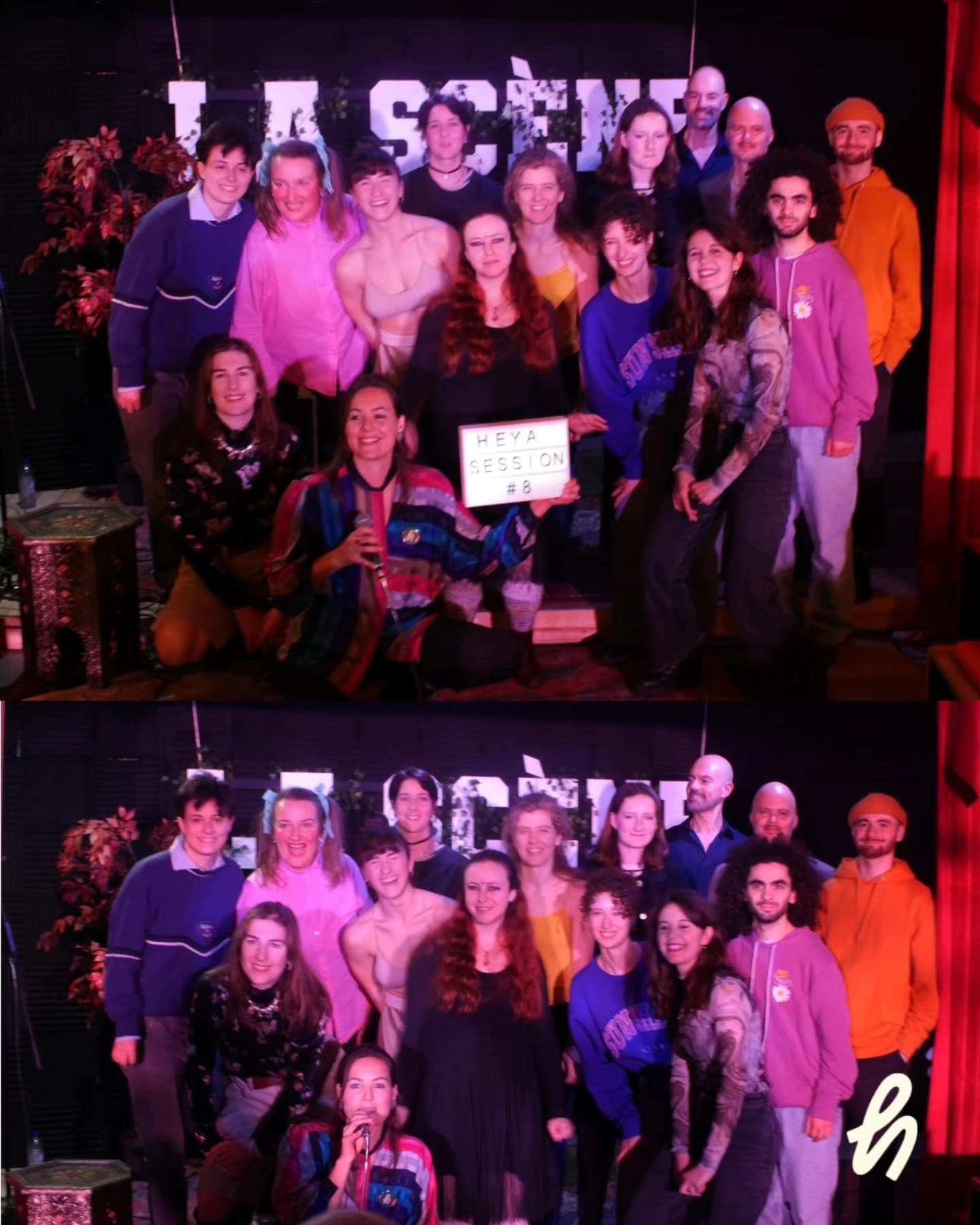
How were the Heya Sessions born?
The idea came about when I met a street musician performing at Place Poelaert, long before HEYA was created. His sound system had run out of battery, so he jokingly said, "Otherwise, I also perform in people's living rooms. Do you have a living room?"
Two weeks later, that same artist, White Corbeau, was performing at my home for the very first living-room concert.
When I later created HEYA, I immediately knew that alongside the digital platform, something had to exist in real life. I remembered that first concert and thought: "Why not simply invite artists to perform and bring people together?"
That is how the Heya Sessions were born.
What makes a Heya Session different from a traditional concert?
A Heya Session is designed specifically for artists, arts professionals, and everyone who loves creativity.
We intentionally create opportunities for professionals to meet other professionals in an environment that naturally encourages conversation. Everyone comes with something to share: business cards, ideas, projects, or simply curiosity.
Each evening is multidisciplinary, bringing artists and audiences together in the same space—both on stage and beyond.
More than just an event, a Heya Session has become a signature format where artistic creation becomes a meeting point. The conversations sparked during the evening often lead to new collaborations.
People always leave with something valuable: a meaningful encounter, a new idea, or an unexpected opportunity.
What do artists and audiences experience during a Heya Session?
For artists, a Heya Session is a form of networking—but designed for people who don't enjoy networking.
Many artists have told me how difficult it can be to approach someone at events where making connections feels expected. During a Heya Session, those conversations happen naturally, without pressure.
Our patrons and mentors play a key role. They build bridges between artists and audiences, help spark conversations, and make it easier for people to connect.
For the audience, it's an evening entirely dedicated to discovery.
Around a dozen artists take the stage, representing a wide variety of disciplines. You might move from stand-up comedy to live music, from slam poetry to dance, from spoken word to performance art.
Each performance lasts around five minutes, creating a succession of unique moments.
This multidisciplinary format encourages a very particular kind of listening—curious, attentive and open-minded—which artists immediately notice and deeply appreciate.
I sometimes like to say that we have the best audience in Brussels... but you'll have to come and see for yourself.
Why are the Heya Sessions at the heart of HEYA’s DNA?
Even though HEYA was initially conceived as a digital hub dedicated to art and culture, I have always known it needed to be rooted in real life. Because our sector needs it. Because no platform will ever replace the richness of a human encounter, the spontaneity of a conversation, or the energy of an evening together.
The Heya Sessions are where this community truly exists: where I can meet it, see it evolve, and most importantly, listen to it. The Here You Art platform is simply a tool, designed for professionals in the cultural sector. It must be useful, accessible, inclusive — and built around their needs. It is not the community that should adapt to the tool, but the tool that must adapt to the community.
How do you select the artists and venues?
For artists, I usually launch an open call about three weeks before each session. I prioritise diversity of proposals, representation across different disciplines, and space given to FINTA artists. While some scenes select artists based on “visibility” or follower count, that is not the case here. At Heya Sessions, what matters is talent, uniqueness, and the desire to share. You will see both emerging and established artists, regardless of their social media “fame”.
For venues, I look for warm and intimate spaces that encourage closeness and connection. It all originally started in my living room — and I try to keep that feeling: a place where you feel at ease, almost like at home. Ultimately, it is as much about the space as it is about the energy created within it.